
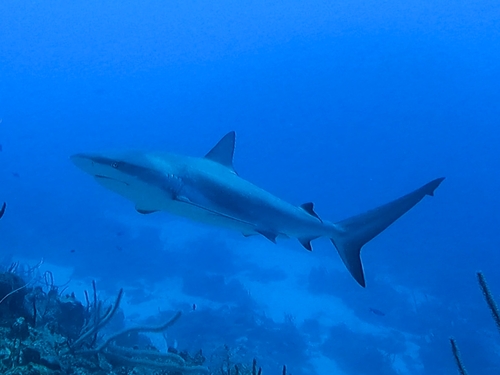
Requin de récif des Caraïbes — voir les destinations où l'observer
Carcharhinus perezii

Caraïbes · Îles Caïmans
Présence documentée, jamais une garantie d'observation.
Carcharhinus perezii

Chelonia mydas
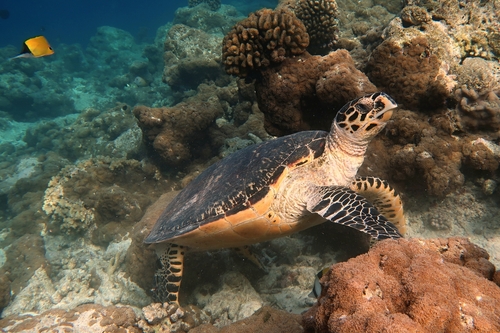
Eretmochelys imbricata
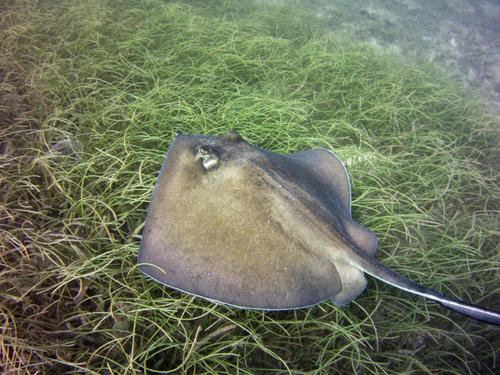
Hypanus americanus
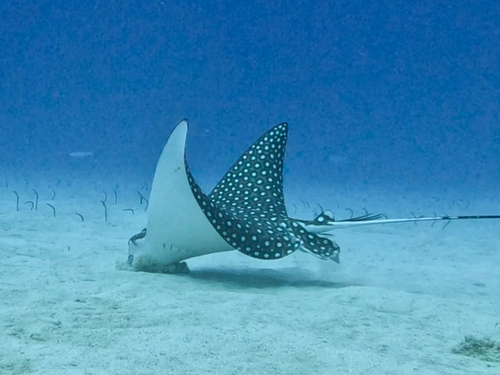
Aetobatus narinari
Faune principale : Requin de récif des Caraïbes, Tortue verte
An East End pinnacle/wall site off Grand Cayman, depth to ~30m/100ft — used by local operators for Advanced Open Water deep-dive training. Squadrons of spotted eagle rays and Caribbean reef sharks are regularly reported, alongside turtles; East End's walls are noted as having more consistent natural (non-baited) shark sightings than elsewhere around the island. Day boat from Ocean Frontiers' East End base, no liveaboard.
The scuba-diveable stingray encounter in North Sound — max depth ~3.6m/12ft, genuinely different from the shallower (~1-1.5m), snorkel/wade-only "Sandbar" nearby that most tourist photos show. Open Water certification is the only requirement stated by operators. Day boat from Seven Mile Beach/George Town, no liveaboard.
Faune principale : Tortue verte
A former US Navy submarine rescue vessel (commissioned 1946), intentionally sunk as an artificial reef in January 2011 off Seven Mile Beach. Highest point ~4.5m below the surface, deepest sections ~18-20m. Garden eels in the surrounding sand attract southern stingrays and spotted eagle rays; also green sea turtles, grouper, and schooling horse-eye jacks. Open Water divers are restricted to decks 1-3 (supervised); Advanced Open Water for full wreck access. Day boat, no liveaboard.
Meilleurs mois documentés
Température de l'eau : normales satellitaires de surface NOAA OISST (2020–2024, plage habituelle du mois). Elle peut être plus fraîche en profondeur ou sous une thermocline — vérifiez la protection thermique avec votre opérateur.